

On Color issues is an article in which Giuseppe Di Giorgio reflects on the use of color models. A color model is a system or framework used to represent and organize colors in a way that they can be understood and reproduced consistently. Di Giorgio is the first guest blogger on Miikny blog.
When Miika asked me to write about color I was struck by some doubts.
I started writing about color and thought that I should tell what color is, then I realized that before knowing what it is I had to know how the final user of color.
The problem doubled, color management differs according to needs.
Let’s take a painting that is going to be printed, as an example. In theory, a painter will mix colors using the three primary colors, red, yellow and blue so dear to the old school of color theory. If then a self-taught person tried to mix color rigidly following the famous Farbkreis by Itten, without having read the book, he would find himself entangled in a system that must be interpreted with a certain elasticity.
In his Farbkreis, Itten starts from a triangle with primary colors at the vertices that evolves into a hexagon with the complementary ones at the added vertices, developing a wheel graph. The wheel with 12 shades of color visually defines the relationships between the primary colors.
The photographer will calibrate the camera and manage the image through the software, using the most suitable RGB color model, based on CIE 1931 color space despite being 30 years older than Itten’s Farbkreis. The CIE developed a mathematical model that explains color spaces from the point of view of a “standard observer”, a mathematical synthesis of the color vision of a normal human eye. Finally the printer will print the image after converting it from RGB to CMYK. The RGB color model has its foundation in the studies made by the CEI, on the aforementioned human perception of colors. The RGB color model was first used in analog photography and tone lighting. Later used in electronic systems and devices, such as televisions and computers. While the RGB color model uses the addition of colors on a black background, the CMYK model is based on the principle of color subtraction and has been the primary printing method for more than a century. The acronym CMYK comes from the four ink plates used: cyan, magenta, yellow, and the key given by black .

Figure 1: Farbkreis Itten
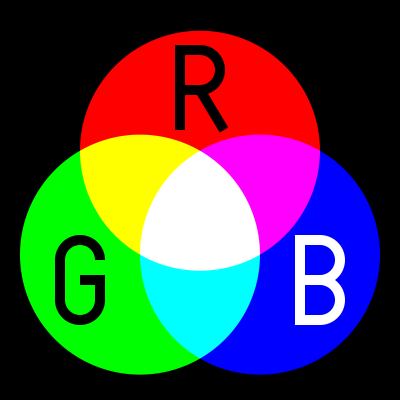
Figure 2: Additive Color

Figure 3: CMYK Color Swatches
I also wondered how to write about Color without mentioning Light, I have never separated the two concepts. The first is a product of the latter. So I decided to return to light to explain color. This article leaves out complex biological notions about the human eye. Because the human eye does not measure color according to its frequency as a spectrometer would.
What is light?
Classical physics defines it as an electromagnetic wave that propagates in a vacuum. It is characterized mainly by its wavelength. In the spectrum visible to the human eye, the wavelength determines the color. In this post we will only talk about the frequency range visible to the human eye, that is, from about 7.5*1014 Hz of violet with a wavelength of about 400 nm to red with a frequency of about 4.3*1014 Hz and a wavelength of about 700 nm.

Figure 4: Electromagnetic spectrum, NASA illustration.
A friend who heard of my interest in measuring color asked me how much the green color measured or weighed. When I asked for the unit of measurement, he replied that a number would be sufficient. So, jokingly, I replied that green was between 500 and 550 nanometers. His surprise was obvious. In meters? he asked. I realized that I had complicated the matter even more by giving the unit of measurement as wavelength.
| Frequency and Wavelength Ranges for Various Colors | ||
| Color | λ0 (nm) | n (THz)* |
| Red | 780–622 | 384–482 |
| Orange | 622–597 | 482–503 |
| Yellow | 597–577 | 503–520 |
| Green | 577–492 | 520–610 |
| Blue | 492–455 | 610–659 |
| Violet | 455–390 | 659–769 |
| *1 terahertz (THz) = 1012 Hz, 1 nanometer (nm) = 10-9 m. | ||
Let’s try to clarify the matter.
In quantum mechanics small particles, like photons, are either defined as waves or particles according to the experiment used to measures them. When light pass a slit and goes through a prism they spread out according to wavelength.
Wavelength is the distance between two positive crests in the oscillations of the electromagnetic field.
Light carries energy and energy in wavelengths is related by a simple inverse relationship
E= hV= hc/λ
Energy is equal to Planck’s constant (h) times the frequency (V) or Planck’s constant (h) times the speed of light (c) divided by the wavelength (λ).
Planck’s constant (6.62606957(29)×10-34 J·s )
Radiation with very long wavelengths will have very low energy, radiation with very short wavelengths will have very high energy.
To close this small journey in the Color field I’ll leave you with an episode about the theoretical physicist Richard Feynman. In an interview, when asked about the mechanisms of magnetism, he replied that, when the subject is very complex, everyone can find the right level of knowledge if they stay within some framework (Cit. You have to be in some framework that allows something to be true). If you want to learn about colors you need to decide the framework given by your application.
In case you should have any questions about the article, please turn to Giuseppe on the comments section.
Sources:
https://en.wikipedia.org/wiki/CIE_1931_color_space
https://en.wikipedia.org/wiki/RYB_color_model
https://en.wikipedia.org/wiki/Johannes_Itten
https://en.wikipedia.org/wiki/RGB_color_model
https://en.wikipedia.org/wiki/CMYK_color_modelhttps://en.wikipedia.org/wiki/Electromagnetic_spectrum#/media/
File:Electromagnetic_spectrum,_NASA_illustration.jpg
Johannes Itten – The Art of Color – ISBN 0-442-24037-6
Eugene Hecht – Optics – ISBN 10: 1-292-09693-4; ISBN 13: 978-1-292-09693-3;
The Science of Color – 2nd Ed. – Steven K. Shevell- ISBN 0–444–512–519

Giuseppe Di Giorgio
Giuseppe Di Giorgio is Italian- rooted engineer who has also keen interest on artistic expressions.
Questioni di colore
Questioni di colore è un articolo nel quale Giuseppe Di Giorgio riflette sull’uso dei modelli cromatici. Un modello di colore è un sistema oppure il contesto utilizzato per rappresentare e organizzare i colori in modo che possano essere compresi e riprodotti in modo consistente. Di Giorgio è il primo guest blogger su Miikny blog.
Quando Miika mi ha chiesto di scrivere sul colore sono stato preso da alcuni dubbi.
Ho iniziato a scrivere sul colore e pensavo che avrei dovuto raccontare cos’è il colore, poi ho capito che prima di saper cos’è dovevo sapere chi è il fruitore del colore.
Il problema diventava doppio, la gestione del colore differisce asseconda delle esigenze.
Prendiamo ad esempio un dipinto che andrà in stampa.
In teoria il pittore mischierà i colori usando il sistema dei tre colori primari, rosso, giallo e blu tanto caro alla vecchia scuola di teoria del colore. Se poi un autodidatta provasse a mischiare il colore seguendo rigidamente la famosa Farbkreis di Itten, senza aver letto il libro, si troverebbe impelagato in un sistema che va interpretato con una certa elasticità.
Con la Farbkreis, Itten parte da un triangolo con in colori primari ai vertici che evolvendosi in un esagono con i complementari nei vertici aggiunti, sviluppa uno schema a ruota. La ruota con 12 tonalità di colore definisce visualmente le relazioni tra i colori primari.
Il fotografo calibrerà la camera e gestirà l’immagine attraverso il software, utilizzando il modello di colore RGB, basato su CIE XYZ (Commission Internationale de l’Eclairage – Commissione internazionale per l’illuminazione)più adatto nonostante sia più vecchio della Farbkreis di Itten di 30 anni. La CIE sviluppò dei modelli matematici che spiegassero gli spazi colore dal punto di un “osservatore standard”, ovvero una sintesi matematica della visione dei colori dell’occhio umano. Infine lo stampatore stamperà l’immagine dopo averla convertita da tricromia (RGB) a quadricromia (CMYK).
Il modello di colore RGB ha le sue fondamenta negli studi fatti dalla CEI, sulla suddetta percezione umana dei colori. Il modello di colore RGB è stato utilizzato daprima nella fotografia analogica e nell’illuminazione a toni. Più tardi nei sistemi e dispositivi elettronici, come televisori e computer. Mentre il modello di colore RGB utilizza l’aggiunta di colori su uno sfondo nero, il modello CMYK si fonda sul pricipio di sottrattivitá del colore ed è stato il metodo di stampa principale per più di un secolo. L’acronimo CMYK deriva dalle quattro piastre di inchiostro utilizzate: ciano, magenta, giallo e la chiave data dal nero.
Figure 1: Farbkreis Itten
Figure 2: Additive Color
Figure 3: CMYK Color Swatches
Mi sono anche chiesto come scrivere di Colore senza menzionare la Luce, non ho mai scisso i due concetti. Il primo è un prodotto del secondo. Ho così deciso di tornare alla luce per spiegare il colore. Il tutto raccontato tralasciando complesse nozioni di biologia sull’occhio umano. In quanto l’occhio umano non misura il colore secondo la sua frequenza come farebbe uno spettrometro.
Cos’è la luce?
La fisica classica la definisce come un’onda elettromagnetica che si propaga nel vuoto. È caratterizzata principalmente dalla sua lunghezza d’onda. Nello spettro visibile all’occhio umano la lunghezza d’onda determina il colore. In questo post parleremo solo dell’intervallo di frequenza visibile all’occhio umano ossia da circa 7.5*1014 Hz del viola con una lunghezza d’onda di circa 400 nm al rosso con una frequenza di circa 4.3*1014 Hz ed una lunghezza d’onda circa 700 nm.
Figure 4: Visualizzazione dello specchio . Immagine di propietá NASA.
Un amico venuto a conoscenza della mio interesse per la misurazione del colore mi chiese quanto pesasse o misurasse il verde. Ad una mia richiesta di unità di misura mi rispose che bastava un numero. Così tra una risata è l’altra ho risposto che il verde stava tra i 500 e i 550 nanometri. La sua sorpresa era evidente. In metri? Mi chiese. Mi resi conto che avevo complicato ancora di più la faccenda dando come unità di misura la lunghezza d’onda.
| Tabella di Lunghezza d’onda e Frequenza, dei colori, nel vuoto. | ||
| Colore | λ0 (nm) | n (THz)* |
| Rosso | 780–622 | 384–482 |
| Arancione | 622–597 | 482–503 |
| Giallo | 597–577 | 503–520 |
| Verde | 577–492 | 520–610 |
| Blu | 492–455 | 610–659 |
| Viola | 455–390 | 659–769 |
| 1 nanometro (nm) = 10-9 m, *1 terahertz (THz) = 1012 Hz. | ||
Vediamo di chiarificare la faccenda.
Nella meccanica quantistica le piccole particelle, come i fotoni, sono definite onde o particelle a seconda dell’esperimento utilizzato per misurarle. Quando la luce passa attraverso una fessura e attraversa un prisma, si diffondono in base alla lunghezza d’onda.
La lunghezza d’onda è la distanza tra due creste positive nelle oscillazioni del campo elettromagnetico.
La luce trasporta energia e l’energia nelle lunghezze d’onda è correlata da una semplice relazione inversa
E= hV= hc/λ
L’energia è uguale alla costante di Planck (h) per la frequenza (V) o alla costante di Planck (h) per la velocità della luce (c) divisa per la lunghezza d’onda (λ).
costante di Planck (6.62606957(29)×10-34 J·s )
La radiazione con lunghezze d’onda molto corte avrà un’energia molto alta, la radiazione con lunghezze d’onda molto lunghe avrà un’energia molto bassa.
Il fisico teorico Richard Feynman, in un intervista, interrogato su i meccanismi del magnetismo rispondeva che, quando l’argomento è molto complesso ognuno può trovare il livello di conoscenza giusto se resta nel giusto contesto (Cit.You have to be in some framework that allow something to be true). Se si vuole apprendere il comportamento del colore si deve decidere il contesto in cui viene applicato.
Nel caso aveste delle domande riguardanti l’articilo potrete porgerle a Giuseppe nella sezione commenti.
Fonti:
https://it.wikipedia.org/wiki/CIE_XYZ
https://it.wikipedia.org/wiki/Modello_di_colore_RYB
https://it.wikipedia.org/wiki/Johannes_Itten
https://it.wikipedia.org/wiki/RGB
https://it.wikipedia.org/wiki/CMYK
https://en.wikipedia.org/wiki/Electromagnetic_spectrum#/media/
File:Electromagnetic_spectrum,_NASA_illustration.jpg
Johannes Itten – The Art of Color – ISBN 0-442-24037-6
Eugene Hecht – Optics – ISBN 10: 1-292-09693-4; ISBN 13: 978-1-292-09693-3;
The Science of Color – Steven K. Shevell- ISBN 0–444–512–519
Giuseppe Di Giorgio
Giuseppe Di Giorgio è un ingegnere italiano con un forte interesse per l’espressione artistica.


Leave a Reply