
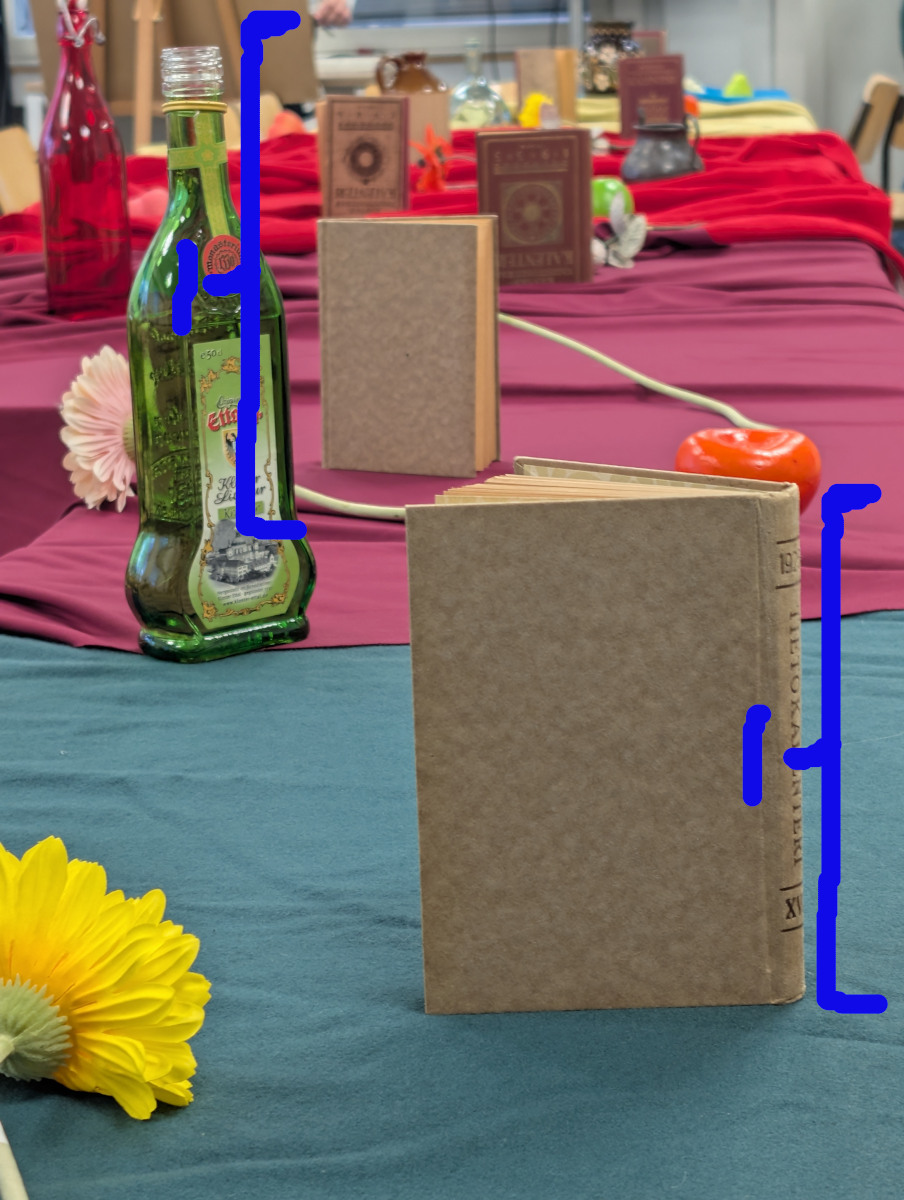
One of my favorite activities in the drawing classes I teach involves turning the classroom desks into a single long table. Along this table, I place identical objects—like books—at one-meter intervals. Half of the students work from one end of the table, while the other half work from the opposite end, drawing with charcoal on paper placed on their easels.
From their positions, each student draws what they see, exploring how same-sized objects appear smaller as they recede into the distance. Through this exercise, students learn to observe and represent spatial depth, noticing how perspective can change the way we perceive size even when the objects themselves are all the same height and width.
This classroom exercise gives students a clear, hands-on introduction to perspective and spatial perception. By placing identical objects (like books) at regular intervals along the long table, students can directly observe how distance affects visual size, foreshortening, and depth representation in their drawings.
From one end of the table, the objects appear to shrink steadily due to linear perspective, and students learn to compare their perceived sizes with their actual sizes. From opposite ends, two groups of students end up producing drawings with reversed vanishing points, which creates an opportunity for class discussion about perspective systems, focal points, and how the human eye perceives depth.
This activity also:
- Highlights relative scale—showing how objects of equal dimension can appear drastically different depending on viewpoint.
- Encourages observational accuracy—students must reconcile what they “know” about object size with what they actually see.
- Provides a natural introduction to vanishing points and converging lines in perspective drawing.
- Allows for comparative critique—students can compare drawings from opposite ends to see how spatial representation changes with vantage point.

Leave a Reply